-----/\------/\------/\------/\---/\------/\------/\------/\----/\---
----
/..\----/./-----/..\----/./--/..\----/..\----/.|-----/..\---\.\--
---
/./\.\--/./-/\--/./\.\--/./--/./\.\--/./\.\--/..|/\--/./\.\--/..\-
--/
..\/./-/./_/ /-/..\-\/-/./--/..\/./--\.\-\/-/./././-/..\-\/-/./\/-
-/
./\../--|.|/./-/./\/---/./--/./\../-/\-\.\--/./|../-/./\/---/./----
-\/-/
./---|././--\.\-----\.\--\/-/./--\.\/./--\/-/./--\.\----/./-----
---
/./----\../----\.\-----\.\---/./----\../-/\--/./----\.\--/./------
---\/------\/------\/------\/---\/------\/--\/--\/------\/--\/-------


---------
news - works - photos - videos - soundstexts ---------

-------- live - aquela máquina - other - archive - contact ------
--

(last update: 12.05.2026)


---

ALL-OVER MAGAZIN 15
; HET PAROOL 22-12-2017 ; METROPOLISM.COM 06-07-2013 ; TUBELIGHT #87 ; THE MIRE ; BAZKULTURMAGAZIN 28-06-2007 ; HET PAROOL 05-09-2005


-- ALL-OVER MAGAZIN, 03.2019 --


Institutional Transpositions

Two Music Exhibitions and the Politics of Attention


Steyn Bergs, March 2019

It is not that we never had music or sound-based work in our museums and art galleries before. Although the following account brackets, for the sake of expediency, the entire history of music’s prior excursions into institutions of visual art as well as of music’s entanglements with the visual arts more generally, the claim here is not that there is anything particularly new about music moving into art spaces. Nor is the present text animated by the desire, often typical of art criticism, to detect, articulate, and possibly evaluate a certain tendency or artistic ‘trend’. Rather, the point of this text is to bring into a constellation two exhibitions to which music was crucial, and which experimented in different ways with inserting music into institutional contexts commonly reserved for contemporary visual art. In doing so, it will be argued that for all their apparent differences, these two exhibitions—Kunsthalle for Music at Witte de With in Rotterdam and w serves imperialism at W139, Amsterdam—shared certain structural features and underlying concerns, and thus resonate with one another. More specifically, the emphasis will be on how both exhibitions experimented with the duration of reception, with the question of who exerts control over this duration (the viewer or the makers of the work and the exhibition), and finally with attention and distraction. More specifically still, these exhibitions’ organization of temporality and experience will be read against the backdrop of our 21st-century attention economy, in which content becomes abundant and ubiquitous, and attention becomes a scarce commodity as a result. Sensing an urgency therein, the parallel reading of these two exhibitions of music—the time-based art par excellence—will illuminate the relations between art institutions and the temporal economies of exhibitions on the one hand, and the attention economy on the other.


Kunsthalle for Music

“Music is not necessarily what you think it is,” proclaims the opening of a manifesto penned by Ari Benjamin Meyers, artistic director of Kunsthalle for Music, initiated by Meyers himself in collaboration with the Witte de With centre for contemporary art in Rotterdam and the Hong Kong-based organization Spring Workshop. The project’s stated aim, then, was to explore and push the boundaries of what we commonly understand music to be. Much like Meyers’ manifesto, the exhibition that took place in Witte de With from January 28 until March 3, 2018, revealed a desire to break away from certain conventions that appear as near-inextricable from dominant tendencies in Western music. Such conventions include the ritual character of the concert or musical performance; the separation, in the social situation of the performance, between an audience and a group of specialized performers or interpreters; the notion that an interpretation or recording is supposed to be faithful not only to the musical score but also to certain conceptions of what is supposedly essential in a specific piece or a specific genre of music. Kunsthalle for Music wanted to (re-)ground music in the everyday, as an embodied experience and lived practice.

As this description reveals, the specter of the avant-garde loomed large over the project—with the (neo-)avant-garde’s musical experimentations, and particularly those of post-Cagean Fluxus, serving as the most apparent point of reference for the project.1 This is furthermore underscored by the articulation of the Kunsthalle’s founding principles in a manifesto—an avant-garde form par excellence. In Peter Bürger’s influential theorization, the historical avant-garde aspired to achieve a fusion of art (or music) and life, a fusion that would ultimately amount to the sublation of art as an institution.2 According to Bürger’s account, the crux of the historical avant-gardes was essentially a radical de-institutionalization of art.3 After all, the historical avant-gardes considered the institution of art a mere by-product of bourgeois ideology, and saw art’s institutions as practico-inert even in respect to this already regressive ideology. The Kunsthalle for Music’s reminiscences of the avant-garde, then, rendered all the more conspicuous the fact that the project proposed not such a de-institutionalization, but rather a transposition of music to the institutional contexts and dispositifs specific to contemporary visual art—specifically, the context of the Kunsthalle, a typically post-war institutional space that is invested in the mounting of temporary exhibitions and does not collect or preserve any works of art.4

During the course of the exhibition at Witte de With—for which the entire art centre was in fact temporarily renamed the Kunsthalle for Music—four musical live performances took place every week. The repertoire consisted of music and of other pieces “based on music”—mostly performance works with some musical component to them. It included pieces by composers such as Charles Ives, but also by characters we mostly associate with the visual arts, from Marcel Duchamp via John Baldessari to Laure Prouvost. A small number of pieces were newly commissioned; works by Jonathan Bepler, Libia Castro & Ólafur Ólafsson, Dominique Gonzalez-Foerster, and The Residents. The repertoire was interpreted by the Kunsthalle for Music Ensemble, which was formed especially for the occasion of the exhibition and consisted of eight musicians and performers with different disciplinary backgrounds, interests, and fields of expertise. The selection and order of the pieces executed by the ensemble was different each time; each visit and each performance were therefore unique. It is not an exaggeration to state that attending the Kunsthalle for Music differed radically from the standard concert experience—and that includes performances of experimental music and avant-garde pieces. Witte de With’s two-storey exhibition space was used in its entirety; with the members of the ensemble scattering through the rooms, congregating for a certain piece, then scattering again. More than anything, the musical experience in the Kunsthalle was designed to feel “informal” as—contrary to the standard concert situation—visitors could enter and leave freely during the duration of the performance and walk around unimpededly as performances were ongoing.

The scare quotes embracing the word “informal” prove necessary here: the experience of informality in the Kunsthalle was not so much the result of a fusion of music with everyday life—a fusion that, as a perhaps caricatural version the avant-garde would have it, would render music formless to the point of becoming unrecognizable. Rather, it was a more or less logical consequence of the fact that most visitors, presumably, were not (yet) accustomed to finding live music being performed in institutional contexts commonly reserved for contemporary art—institutions that we associate with certain experiential and attentional forms, and certain modes of reception. What occurred here was not a de-institutionalization of music, but rather its transposition from one institutional context to another. In other words, music was extrapolated from its usual, traditional framework, and thereby, to some extent, temporarily rescued from some of the reifications that this institutional framework brings about. At the same time, however, it was also subjected immediately to a different set of institutional codes and conditions—those of the contemporary art world—not at least because these codes and conditions are embodied and internalized by the visitors of Witte de With, who entered the premises carrying with them a specific set of institutional habits.5 In that respect, it was telling that the Kunsthalle for Music could also be visited during Witte de With’s regular opening times, when no live performances were taking place. First and foremost, visitors then encountered—apart from a number of musical instruments, some musical paraphernalia, and a small number of artworks and wall labels—the radiant emptiness of the white cube itself. And indeed, it was this dispositif that was made to shine with the promise of emancipating music from the institutional reifications with which it has arguably become all too merged.

Such a promise is to be taken seriously, but also with a grain of salt. An illuminating historical analogy is offered here by the so-called documentary turn in art that, in a not too distant past, sought to do away with some of the conventions crusted into the genre of documentary film, and to do so specifically by moving film away from cinema, and into the art world.6 The documentary turn effectively amounted to an explosion of interesting work that approached documentary film-making in a new way. Yet, it also demonstrated the speed and ease with which the contemporary art world absorbs the shocks of the new—shocks which in fact keep its machinery running. Moreover, this analogy with the documentary turn is valuable because, in the case of the documentary turn, too, it was specifically the temporal structure of the museum experience that was credited with a certain emancipatory potential. As the visitor could move around freely through the exhibition space, it was no longer exclusively the duration of video works that determined the duration of reception.7 Another, still more recent point of reference could be the surge of experimentation with dance performances in visual art institutions.8 In these cases, as in the Kunsthalle, the individual museum-going subject’s power to determine the duration of their own processes of attentive contemplation is pitted against the traditional immobilization of audiences and spectators in concert halls, theatres, and cinemas, where the time of reception is carefully administered. This is an operation that will succeed at catching exhibition-goers off guard for as long as they remain unaccustomed to these newly proposed modalities of reception, but a revolutionization (of documentary film, of dance, of music) it is not—nor, we might perhaps add, does it need to be.

Kunsthalle for Music’s informality, as well as its intended problematization of the “ontology” of music, consisted first and foremost of subjecting music to the diffuse and scattered forms of reception normally reserved for visual art.9 And indeed, this move did result in an a-typical, “fresh” musical experience. In that sense, this undertaking can be considered a generative experiment with strategies of reframing and recontextualization—in particular, with what has been called here the institutional transposition of music. At the same time, one does not need to adhere to an obstinate and conservative cultural pessimism to see that it also effects a certain loss, a certain impoverishment of musical experience. It is true that the institutional dispositif of the Kunsthalle for Music did not impose the rigid, passive, and petrified form of contemplation still commonly associated with “high” culture in the same way as, for example, a classical concert set-up does. An important point, however, is that it is precisely this abandonment and this “informality” that makes the Kunsthalle (and the white cube in general) the institutional format most conveniently in synch with our 21st-century attention economy, characterized as it is by an abundance of content (text, image, sound, information) and a relative scarcity of our human attentive capacities—our potential to stay interested, to process, and ultimately to care.10 Everyone who visits art exhibitions regularly will be well-familiar with the blasé attitudes they can often foster, and is therefore likely to be skeptical about the supposed emancipatory potential of the museum or exhibition space for music.11 Nonetheless, it will prove fruitful here not to settle on any final conclusions—let alone judgments—on the project quite yet, and to instead move on to a discussion of an exhibition that was in many respects dissimilar and dissonant to the Kunsthalle for Music, yet was underpinned by some of the same concerns and engaged in a related experimentation with the duration of reception, with the “freedom” and sovereignty of the exhibition-goer, and with questions of attentiveness and distraction.


w serves imperialism

w serves imperialism was on view at W139, an artist-run project space in Amsterdam, from December 15, 2017, till January 21, 2018. Conceived and curated by W139 members and artists André Avelãs and Anami Schrijvers, it featured sound, video, installation, and music pieces by Avelãs himself, James Beckett, Cornelius Cardew, Nicolas Collins, DNK-Ensemble, Gijs Gieskens, Experimental Jetset, Joseph Kudirka, Brian McKenna, Jonathan Mikkelsen, Koen Nutters, Mike Ottink, Tristan Perich, Gert-Jan Prins, Natalia Domínguez Rangel, Paulo Raposo, Jasna Veličković, and Bas van Koolwijk. None of these pieces hinged on an element of live performance, nor were they, in and of themselves, pieces of music: most were installations, mobiles, or video works in which the sound component was particularly pertinent.12 Much like Kunsthalle for Music, the exhibition looked to the avant-garde for inspiration, albeit a somewhat different avant-garde. While Ari Benjamin Meyers referred to (neo-)avant-garde musical practices more generally, the makers of w serves imperialism looked specifically to the aforementioned figure of Cornelius Cardew. A composer initially influenced strongly by Cage, Cardew pioneered musical experiments with noise and improvisation before becoming increasingly involved with Marxist-Leninist politics. These political inclinations would quickly lead him to not only give up composing avant-garde or experimental music, but also to condemn it as elitist. He started composing in a more accessible idiom, often drawing on folk and popular music and writing in the service of the party. He denounced the musical avant-garde as well as his prior engagements with it in his scathing book Stockhausen Serves Imperialism—the source for the title of the W139 exhibition.13

In Kunsthalle for Music, issues relating to the temporal structure of the exhibition experience and its implication in the attention economy were ever-present yet nowhere explicit; they served as the background against which the insertion of music in the exhibition space could stand out as novel and singular. By contrast, w serves imperialism was emphatic about bringing these issues to the fore. The accompanying exhibition text made clear reference to the attention economy and its ramifications for how we experience art and exhibitions:

The current state of media consumption renders us subjects of a sinister attention economy, making multitasking and superficial scrolling norms. This is the manner in which we often move through exhibitions as well, supposedly browsing art with a mere 9 seconds dedicated per artwork. With w serves imperialism, we seek an antithesis, a conceptual approach of curating conscious and qualitative art experiences that provides the time and space to engage in-depth.14

This antithetical proposition vis-à-vis the attention economy was nothing if not radical. The exhibition’s visitors would enter W139’s exhibition hall through a black curtain, to find the entire space shrouded in a pitch-black and disorienting darkness. Though no wall texts were present to warn visitors about what to expect, the exhibition’s structure would reveal itself soon enough. Essentially, the various artworks in w serves imperialism were subsumed into one single installation, a unified Gesamtkunstwerk that employed an intricate technical system to illuminate and activate the works in the show: when a given work was lit and operative, all others would be utterly invisible and mute. The various pieces in the exhibition, therefore, could only be experienced one by one, in the order mandated by the exhibition itself. They were not always shown in the exact same sequence, though, and sometimes a specific work was turned on more than once in one exhibition “cycle”. Thus, the duration of reception here was dictated by the exhibition structure rather than by the visitors themselves. This was the case not only for the individual artworks, but also for the exhibition as a whole—which took about 1,5 hours to consume, if one wanted to see every work at least once. Though not at all unpleasant, the experience of visiting w serves imperialism was one of giving up control and submitting oneself entirely to the exhibition’s dispositif, to its carefully composed program of stimuli. In its use of shock tactics as well as of subtlety, this program was extreme: some works were deafening, others barely made a whisper; certain pieces would form a stroboscopic attack on visitors’ eyesight—severely sensitized by the obscurity of the exhibition space—while some were so scantly lit that they were hard to even locate in the darkness. Needless to say, this was a firm curatorial setup if ever there was one: not only did it impose a specific rhythmic pattern of reception on its visitors, but it required that the participating artists had to agree to an exhibition format in which their work would in fact be invisible and inaudible for most of the time. In Leninist politics such as Cardew’s, liberation and emancipation are to be achieved by giving oneself over to the programmatic stringency of the party, effacing one’s individual desires and particularities to better meet the exigencies of the revolutionary horizon. Somewhat analogously, the proposition of w serves imperialism was that subsumption into the machine-like and rather relentless apparatus of this total installation, while suspending the sovereignty of the exhibition-goer to control the time of contemplation, would ultimately enable a deeper, more qualitative attentive engagement with art.

In several ways, then, w serves imperialism functions as a perfect counterpoint to Kunsthalle for Music. Where musical performances in the first exhibition reveled in the brightness of the white cube—a luminosity that has always functioned ideologically as a cipher for a certain faith in the public sphere, for transparency, and ultimately for Enlightenment itself—the second created what Noam Elcott has termed artificial darkness, establishing an affinity with the experiential forms associated with cinema and the theatre or concert hall, rather than with traditional exhibition spaces.15 While Kunsthalle visitors roamed freely through the exhibition space, their itinerary through w serves imperialism was largely predetermined. While the former exhibition was predicated on notions of informality, improvisation, and play, the latter mounted a highly rigid structure. The scattered, distributed distraction of the Kunsthalle diametrically opposed w serves imperialism’s commanding centralization and concentration of attention. Simultaneity in the Kunsthalle became sequence in w serves imperialism; chaos became order. Ultimately, they were two very different but complementary institutional transpositions: whereas the Kunsthalle kept the attentional modality of the exhibition space intact, seeking to explore how music would function and transform under its conditions, w serves imperialism was ultimately more invested in challenging and overhauling those conditions, with the quintessentially temporal and durational nature of music serving as a model for doing so. Even though visitors could of course still leave the exhibition at any given point, or just roam through the darkness as they desired, disregarding the switching-on and switching-off of works, it is not an exaggeration to state that w serves imperialism, in bargaining away some of the viewers’ autonomy over the time of reception, began to move away from the institutional framework of the art exhibition, toward that of the concert. Though the exhibition contained no musical pieces—at least not in any conventional understanding—its arrangement was musical in that it aligned the duration of successive pieces with the attention paid by its visitors.16 While the Kunsthalle set out to demonstrate that music is not necessarily what we think it is precisely by moving away from the concert setting and inserting music into an art institutional context, in w serves imperialism it was the institutional context itself that was transfigured through music. It is in this sense that the exhibition was radical: it challenged certain deep-rooted presuppositions of what an exhibition is, and of what forms of experience it affords. It did so specifically by tampering with the freedom visitors are accustomed to having over their time in the exhibition space, and with the distracted reception this freedom more often than not results in.

On an imagined spectrum of attentive modalities, from hyperdistracted to hyperconcentrated, these two exhibitions would have to be situated at opposite ends. However, simply presenting them as antithetical and contradictory to one another would ultimately be reductive. In their ways of organizing duration and attention, the Kunsthalle and w serves imperialism present diverging responses to the attention economy and the challenges it poses for cultural experience. It is important to grasp both responses at once, and dialectically, as both have their own merits as well as their shortcomings when it comes to facing those challenges. Clearly, the issue with the former is that it rather uncritically employs the institutional frame of the exhibition as an instrument for emancipating music and musical experience, neglecting this institutional frame’s increasing entanglement with the attention economy altogether. With the latter, which does explicitly address issues of attentiveness, the trouble is not so much with its “authoritarian” tendencies (lest we forget that authoritarian exhibition concepts are still a far stretch from authoritarian states) as with its cursory acceptance of the presumption that “conscious and qualitative art experiences” and “in-depth” engagements are intrinsically desirable or superior. As even a quick glance at the passage of Benjamin’s Artwork essay referred to above reveals, such a presumption—though admittedly it acquires new implications under the attention economy—is not without its ideological and arguably elitist connotations. Furthermore, keeping the dialectical tension between these two shows in suspension proves helpful in avoiding overly schematic or totalizing understandings of the attention economy (and the ubiquitous and tiresome complaints concerning the supposedly microscopic attention spans of “millenials” certainly demonstrate how tempting such simplifications are), or of what an appropriate rejoinder to it might entail in the field of culture.

Finally, it should be made explicit that throughout this account, questions of control and sovereignty over the time of spectatorship have figured metonymically for struggles over time in general, and therefore ultimately for politics itself. Different attentive modalities, from the dispersed to the concentrated, have been correlative to different political forms, from the molecular revolutions of individual liberation to the regimented organization of party politics. When it comes to these political forms, too, apprehending seeming opposites dialectically seems more productive than seeing them as mutually exclusive of each other. It can be a way of keeping things open, of keeping things productively and pleasantly messy.

--

1 See, for instance, Liz Kotz, Post-Cagean Aesthetics and the “Event” Score”, in: October, Vol. 95, Winter 2001, pp. 54 – 89.

2 Peter Bürger, Theory of the Avant-Garde, Minneapolis 1984, p. 24 – 25.

3 This de-institutionalization designates not just an escape from (established) art institutions, but rather the withering of art itself as an institution. Bürger distinguished between the historical avant-gardes (essentially Futurism, Dadaism, and Surrealism) and the neo-avant-garde of the late 1960s and early 1970s, famously critiquing the latter for offering not more than an immanent critique of the institution of art. For an equally famous riposte to Bürger, see: Hal Foster, Who’s Afraid of the Neo-Avant-Garde?, in: Hal Foster, The Return of the Real, Cambridge, MA 1996, p. 1 – 34.

4 This is also how Witte de With itself operates. Like most Kunsthalles, Witte de With is a not-for-profit (and publicly funded) institution.

5 The use of “institutional habits” here is inspired by, but not identical to, Sara Ahmed’s work on the subject. Sara Ahmed, Institutional Habits, in: feministkilljoys, February 2, 2015. URL: https://feministkilljoys.com/2015/02/02/institutional-habits/ [06.05.2018].

6 Erika Balsom/Hila Peleg, Introduction: The Documentary Attitude, in: Erika Balson/Hila Peleg (eds.), Documentary Across Disciplines, Cambridge, MA 2016, p. 10 – 19 (16).

7 Boris Groys, From Image to File – And Back: Art in the Age of Digitalization, in: Boris Groys, Art Power, Cambridge, MA 2008, p. 83 – 91 (88).

8 On the temporal economies of dance and performance exhibitions, see: Sven Lütticken, Dance Factory, in: Mousse, No. 50, October 2015, p. 90 – 103.

9 Note how the contemporary museum or exhibition experience in this sense approximates what Walter Benjamin famously theorized, in the artwork essay, as “reception in distraction.” However, habituation to reception in distraction was modeled by Benjamin after the experience of architecture and popular media such as film, and was to serve as an antidote for the attentive model of immersive contemplation that Benjamin associated with (the ideology of) high art. Walter Benjamin, The Work of Art in the Age of Its Technological Reproducibility: Second Version, in: Michael W. Jennings/Brigid Doherty/Thomas Y. Levin (eds.), The Work of Art in the Age of Its Technological Reproducibility and Other Writings on Media, Cambridge MA 2008, p. 40 – 41.

10 Tiziana Terranova, Attention, Economy and the Brain, in: Culture Machine, Vol. 13, 2012. p. 1 – 19. Somewhat more recently, we have seen several calls for a more conscious cultivation of human attentive capacities in the face of the digital attention economy, such as Isabelle Stengers’ “art of paying attention” and Yves Citton’s ecological understanding of attention. Isabelle Stengers, In Catastrophic Times: Resisting the Coming Barbarism, Lüneburg 2015, p. 61 – 62. Yves Citton, The Ecology of Attention, Cambridge 2017.

11 The evocation of “blasé attitudes” here serves not at all to pass a judgment on the supposed snobbishness of exhibition-goers. Rather, in accordance with Simmel’s exploration of the term, it is intended as a more or less neutral description of the defensive responses subjects develop in the face of overstimulation. Georg Simmel, The Metropolis and Mental Life, in: Gary Bridge/Sophie Watson (eds.), The Blackwell City Reader, Oxford and Malden, MA, 2002, p. 11 – 19 (14).

12 Several events were organized within the framework of w serves imperialism that did include live performance, but these are sidelined here so as to keep focus strictly on the exhibition itself.

13 For more on Cardew, see: Virginia Anderson, Cornelius Cardew lives, in: openDemocracy, December 12, 2011. URL: https://www.opendemocracy.net/arts-Music/cardew_3509.jsp [06.05.2018].

14 W139, w serves imperialism, in: W139, s.d. URL: http://w139.nl/en/article/25152/w-serves-imperialism/ [06.05.2018].

15 Elcott traces the history of the specifically modern dispositif of artificial darkness – “a technology of visibility and invisibility” – from Wagner’s musical dramas to the cinema and avant-garde movements of the early 20th century. His descriptions of it, however, fit w serves imperialism seamlessly. Noam Elcott, Artificial Darkness: An Obscure History of Modern Art and Media, Chicago/London 2016, p. 11.

16 One important difference, however, is that in the case of a musical concert or programme, duration is proper to the musical pieces themselves, whereas the duration of the singular pieces in w serves imperialism did not always have an intrinsic link to the qualities of the artworks themselves but was determined by the exhibition’s overarching structure, and thus by the curators.

--

Steyn Bergs is an art critic and a researcher. Currently, he is conducting his PhD research on the commodification of digital artworks at Vrije Universiteit Amsterdam. From 2016 to 2018, together with Rosa te Velde, he was co-editor-inchief of Kunstlicht, a journal for visual art, visual culture, and architecture. His writing has appeared in various magazines and journals.


-------------
top


-- HET PAROOL, 22.12.2017 --


HET PAROOL, VRIJDAG 22 DECEMBER 2017


W SERVES IMPERIALIM
---------------------------
DIVERSE KUNSTENAARS
---------------------------
Waar W139, Warmoestraat 139
---------------------------
Te zien t/m 21/1
---------------------------


*****


In het Russische Penza, een stad ruim 600 kilometer ten zuidoosten van Moskou, staat 'Het Museum van Een Schilderij, vernoemd naar G.V. Mjasnikov'. Het is een wonderlijk museum, waar steeds maar één schilderij uit de collectie te zien is. Voordat de bezoeker het schilderij kan bekijken, wordt een film van drie kwartier vertoond waarin historische achtergronden van het schilderij en de maker worden belicht. Het idee is dat je door een investering van tijd en concentratie een unieke kijkervaring krijgt.

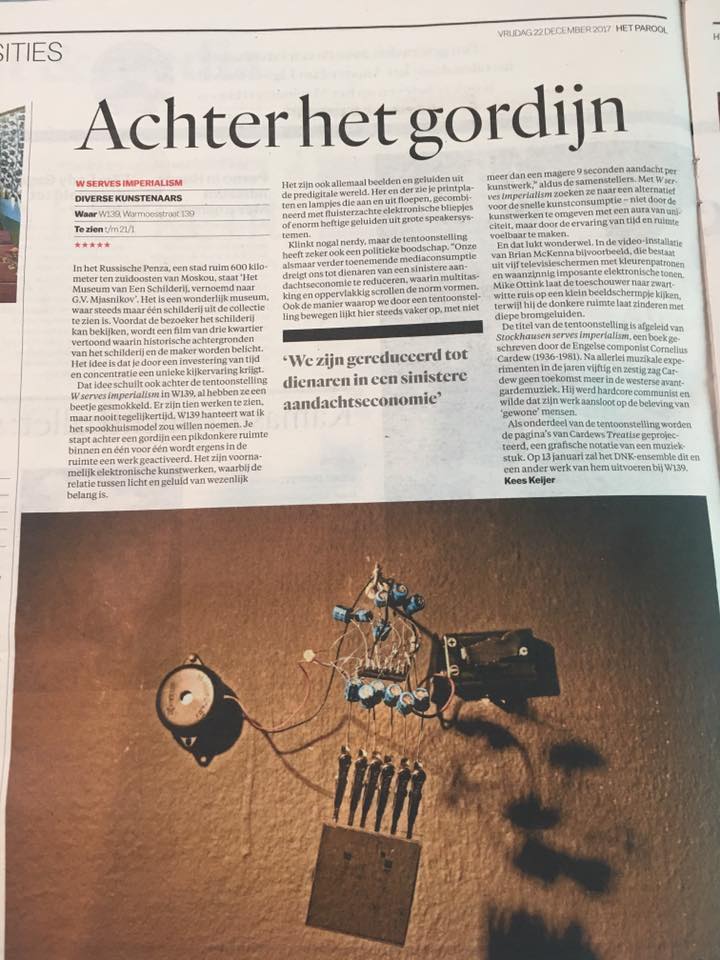
Dat idee schullt ook achter de tentoonstelling W serves imperialism in W139, al hebben ze een beetje gesmokkeld. Er zijn tien werken te zien, maar nooit tegelijkertijd. W139 hanteert wat ik het spookhuismodel zou willen noemen. Je stapt achter een gordijn een pikdonkere ruimte binnen en één voor één wordt ergens in de ruimte een werk geactiveerd. Het zijn voornamelijk elektronische kunstwerken, waarbij de relatie tussen licht en geluid van wezenlijk belang is.

Het zijn ook allemaal beelden en geluiden uit de predigitale wereld. Her en der zie je printplaten en lampjes die aan en uit floepen, gecombineerd met fluisterzachte elektronische bliepjes of enorm heftige geluiden uit grote speakersystemen..

Klinkt nogal nerdy, maar de tentoonstelling heeft zeker ook een politieke boodschap. "Onze alsmaar verder toenemende mediaconumptie dreigt ons tot dienaren van een sinistere aandacchtseconomie te reduceren, waarin multitasking en oppervlakkig scrollen de norm vormen. Ook de manier waarop we door een tentoonstelling bewegen lijkt hier steeds vaker op, met niet meer dan een magere 9 seconden aandacht per kunstwerk," aldus de samenstellers. Met W serves imperialism zoeken ze naar een alternatief voor de snelle kunstcomsumptie - niet door de kunstwerken te omgeven met een aura van uniciteit, maar door de ervaring van tijd en ruimte voelbaar te maken.

En dat lukt wonderwel. In de video-installatie van Brian McKenna bijvoorbeeld, die bestaat uit vijf televisieschermen met kleurenpatronen en waanzinnig imposante elektronische tonen. Mike Ottink laat de toeschouwer naar zwart-witte ruis op een klein beeldschermpje kijken, terwijl hij de donkere ruimte laat sinderen met diepe bromgeluiden.

De titel van de tentoonstelling is afgeleid van Stockhausen serves imperialism, een boek gescreven door de Engelse componist Cornelius Cardew (1936-1981). Na allerlei muzikale experimenten in de jaren vijftig en zestig zag Cardew geen toekomst meer in de westerse avantgardemuziek. Hij werd hardcore communist en wilde dat zijn werk aansloot op de beleving van 'gewone' mensen.

Als onderdeel van de temtoonstelling worden de pagina's van Cardews Treatise geprojecteerd, een grafische notatie van een muziekstud. Op 13 january zal het DNK-ensenble dit en ander werk van hem uitvoeren bij W139.

Kees Keijer


-- translation --


In the Russian Penza, a city more than 600 kilometers southeast of Moscow, stands 'The Museum of One Painting, named after G.V. Mjasnikov'. It is a wonderful museum, where only one painting from the collection can be seen at a time. Before the visitor can view the painting, a film of three quarters of an hour is shown in which historical backgrounds of the painting and the maker are highlighted. The idea is that you get a unique viewing experience through an investment of time and concentration.

That idea is also behind the exhibition W serves imperialism in W139, although they have smuggled it a bit. There are ten works to be seen, but never at the same time. W139 uses what I would call the haunted house model. You step behind a curtain into a pitch dark room and one by one a work is activated somewhere in the room. They are primarily electronic works of art, in which the relationship between light and sound is essential.

It is also all images and sounds from the predigital world. Here and there you can see printed circuit boards and lights that blink on and off, combined with whisper-quiet electronic bleeps or extremely loud sounds from large speaker systems.

Sounds pretty nerdy, but the exhibition certainly has a political message. "Our ever-increasing media consumption threatens to reduce us to servants of a sinister business economy, where multitasking and superficial scrolling are the norm, and the way we move through an exhibition seems more and more like that, with no more than a mere 9 seconds of attention per artwork," say the exhibitors. With W serves imperialism they are looking for an alternative to fast art consumption - not by surrounding the artworks with an aura of uniqueness, but by making the experience of time and space tangible.

And that works perfectly. For example, in Brian McKenna's video installation, which consists of five television screens with color patterns and insanely impressive electronic tones. Mike Ottink lets the viewer watch black and white noise on a small screen, while he lets the dark room spin with deep humming sounds.

The title of the exhibition is derived from Stockhausen serves imperialism, a book written by the English composer Cornelius Cardew (1936-1981). After all kinds of musical experiments in the fifties and sixties, Cardew saw no future in Western avant-garde music. He became a hardcore communist and wanted his work to fit in with the experience of 'ordinary' people.

As part of the exhibition, the pages of Cardews Treatise are projected, a graphical notation of a music study. On Jan. 13, the DNK-ensenble will perform this and other work of him at W139.

(google translated)


------------- top


-- METROPOLISM.COM, 06.07.2013 --


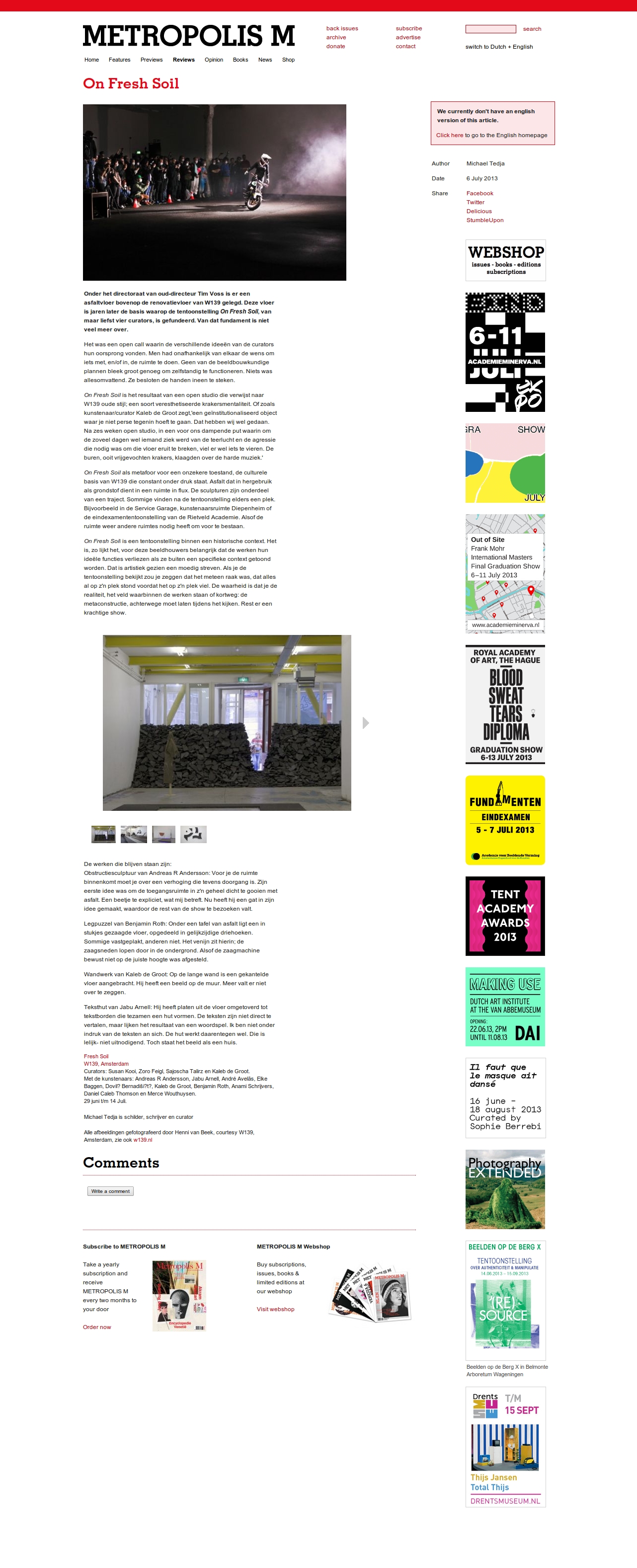
On Fresh Soil


Onder het directoraat van oud-directeur Tim Voss is er een asfaltvloer bovenop de renovatievloer van W139 gelegd. Deze vloer is jaren later de basis waarop de tentoonstelling On Fresh Soil, van maar liefst vier curators, is gefundeerd. Van dat fundament is niet veel meer over.

Het was een open call waarin de verschillende ideeën van de curators hun oorsprong vonden. Men had onafhankelijk van elkaar de wens om iets met, en/of in, de ruimte te doen. Geen van de beeldbouwkundige plannen bleek groot genoeg om zelfstandig te functioneren. Niets was allesomvattend. Ze besloten de handen ineen te steken.


On Fresh Soil is het resultaat van een open studio die verwijst naar W139 oude stijl; een soort veresthetiseerde krakersmentaliteit. Of zoals kunstenaar/curator Kaleb de Groot zegt,'een geïnstitutionaliseerd object waar je niet perse tegenin hoeft te gaan. Dat hebben wij wel gedaan. Na zes weken open studio, in een voor ons dampende put waarin om de zoveel dagen wel iemand ziek werd van de teerlucht en de agressie die nodig was om die vloer eruit te breken, viel er wel iets te vieren. De buren, ooit vrijgevochten krakers, klaagden over de harde muziek.'

On Fresh Soil als metafoor voor een onzekere toestand, de culturele basis van W139 die constant onder druk staat. Asfalt dat in hergebruik als grondstof dient in een ruimte in flux. De sculpturen zijn onderdeel van een traject. Sommige vinden na de tentoonstelling elders een plek. Bijvoorbeeld in de Service Garage, kunstenaarsuimte Diepenheim of de eindexamententoonstelling van de Rietveld Academie. Alsof de ruimte weer andere ruimtes nodig heeft om voor te bestaan.

On Fresh Soil is een tentoonstelling binnen een historische context. Het is, zo lijkt het, voor deze beeldhouwers belangrijk dat de werken hun ideële functies verliezen als ze buiten een specifieke context getoond worden. Dat is artistiek gezien een moedig streven. Als je de tentoonstelling bekijkt zou je zeggen dat het meteen raak was, dat alles al op z'n plek stond voordat het op z'n plek viel. De waarheid is dat je de realiteit, het veld waarbinnen de werken staan of kortweg: de metaconstructie, achterwege moet laten tijdens het kijken. Rest er een krachtige show.

De werken die blijven staan zijn:
Obstructiesculptuur van Andreas R Andersson: Voor je de ruimte binnenkomt moet je over een verhoging die tevens doorgang is. Zijn eerste idee was om de toegangsruimte in z'n geheel dicht te gooien met asfalt. Een beetje te expliciet, wat mij betreft. Nu heeft hij een gat in zijn idee gemaakt, waardoor de rest van de show te bezoeken valt.

Legpuzzel van Benjamin Roth: Onder een tafel van asfalt ligt een in stukjes gezaagde vloer, opgedeeld in gelijkzijdige driehoeken. Sommige vastgeplakt, anderen niet. Het venijn zit hierin; de zaagsneden lopen door in de ondergrond. Alsof de zaagmachine bewust niet op de juiste hoogte was afgesteld.

Wandwerk van Kaleb de Groot: Op de lange wand is een gekantelde vloer aangebracht. Hij heeft een beeld op de muur. Meer valt er niet over te zeggen.

Teksthut van Jabu Arnell: Hij heeft platen uit de vloer omgetoverd tot tekstborden die tezamen een hut vormen. De teksten zijn niet direct te vertalen, maar lijken het resultaat van een woordspel. Ik ben niet onder indruk van de teksten an sich. De hut werkt daarentegen wel. Die is lelijk- niet uitnodigend. Toch staat het beeld als een huis.


On Fresh Soil
W139, Amsterdam

Curators: Susan Kooi, Zoro Feigl, Sajoscha Talirz en Kaleb de Groot.
Met de kunstenaars: Andreas R Andersson, Jabu Arnell, André Avelãs, Elke Baggen, Dovil? Bernadiši?t?, Kaleb de Groot, Benjamin Roth, Anami Schrijvers, Daniel Caleb Thomson en Merce Wouthuysen.
29 juni t/m 14 Juli.


Michael Tedja is schilder, schrijver en curator


-- translation --


On Fresh Soil


Under the directorship of former director Tim Voss, an asphalt floor was laid on top of the renovated floor of W139. Years later, this floor is the foundation upon which the exhibition On Fresh Soil, curated by no fewer than four curators, is based. Not much of that foundation remains.

It was an open call in which the curators' various ideas originated. Independently of one another, they shared the desire to do something with, and/or within, the space. None of the architectural plans proved large enough to function independently. Nothing was all-encompassing. They decided to join forces.

On Fresh Soil is the result of an open studio that references the old style of W139; a kind of aestheticized squatter mentality. Or, as artist/curator Kaleb de Groot puts it, 'an institutionalized object that you don't necessarily have to oppose.’ Yet that is exactly what we did. After six weeks of open studio, in what felt like a steaming pit to us—where someone would fall ill every few days from the smell of tar and the aggression required to break up that floor—there was certainly something to celebrate. The neighbors, once free-spirited squatters, complained about the loud music.

On Fresh Soil as a metaphor for an uncertain state, the cultural foundation of W139 that is constantly under pressure. Asphalt serving as a raw material in a space in flux through reuse. The sculptures are part of a trajectory. Some find a place elsewhere after the exhibition. For example, in the Service Garage, the Diepenheim artist space, or the graduation exhibition of the Rietveld Academy. As if the space needs other spaces to exist again.

On Fresh Soil is an exhibition within a historical context. It seems important to these sculptors that the works lose their ideal functions when shown outside a specific context. From an artistic perspective, that is a courageous endeavor. Looking at the exhibition, you might say that it hit the mark immediately, that everything was already in place before it fell into place. The truth is that you have to set aside reality—the field in which the works stand, or simply put: the meta-construction—while viewing. What remains is a powerful show.

The works that remain are:

Obstruction Sculpture by Andreas R Andersson: Before entering the space, you have to cross a raised platform that also serves as a passageway. His initial idea was to completely fill the entrance area with asphalt. A bit too explicit, as far as I am concerned. Now he has created a hole in his idea, allowing the rest of the show to be visited.

Jigsaw Puzzle by Benjamin Roth: Beneath a table of asphalt lies a floor sawn into pieces, divided into equilateral triangles. Some are glued down, others are not. The sting lies here; the saw cuts extend into the subfloor. As if the saw machine was deliberately not set to the correct height. Wallwork by Kaleb de Groot: A tilted floor has been installed on the long wall. He has a sculpture on the wall. There is nothing more to say about it.

Text Hut by Jabu Arnell: He has transformed slabs from the floor into text boards that together form a hut. The texts cannot be directly translated, but seem to be the result of a wordplay. I am not impressed by the texts per se. The hut, on the other hand, does work. It is ugly—not inviting. Yet the sculpture stands firm.


On Fresh Soil
W139, Amsterdam
Curators: Susan Kooi, Zoro Feigl, Sajoscha Talirz, and Kaleb de Groot.
With the artists: Andreas R Andersson, Jabu Arnell, André Avelãs, Elke Baggen, Dovilč Bernadišićtć, Kaleb de Groot, Benjamin Roth, Anami Schrijvers, Daniel Caleb Thomson, and Merce Wouthuysen.
June 29 to July 14.


Michael Tedja is a painter, writer, and curator


------------- top


-- TUBELIGHT #87, 07, 08.2013 --


Omgeploegd

ON FRESH SOIL

with Andreas R AnderssonJabu ArnellAndré AvelãsElke Baggen, Dovilė Bernadišiūtė, Kaleb de GrootBenjamin Roth, Anami Schrijvers, Daniel Caleb Thomson, Merce Wouthuysen

t/m 27 juni
W139, Warmoestraat 139, Amsterdam
www.w139.nl


Miriam van Ommeren


Pindakaas, zonnebloempitten, een gapend gat. De vloer lijkt het minst interessante deel van een tentoonstellingsruimte, slechts bedoeld om overheen te lopen of om kunstwerken te dragen, maar sommige kunstenaars draaien het om en maken juist de vloer tot het centerpiece van hun werk.

Wim T. Schippers bedacht in 1962 zijn beroemde pindakaasvloer, die hij daarna slechts tweemaal tentoonstelde. Schippers' kleverige vloer, gevat in een lijst, deed bezoekers uitglijden of zorgde er juist voor dat ze aan de vloer bleven vastplakken. Men klaagde over de verstikkende lucht die er van af kwam, en in het Centraal Museum (1997) gooiden scholieren pakken hagelslag leeg over de vloer. het deerde Schippers allemaal niet: zijn vloer symboliseerde immers de onzinnigheid van het leven. Zinloos, maar daarom nog wel de moeite waard, zoals een jaarvoorraad broodbeleg op de grond. Museum Boijmans van Beuningen kocht het werk in 2011 aan.

De Colombiaanse kunstenaar Doris Salcedo (1958) pakte het in 2007 een stuk rigoureuzer, en ook symbolischer, aan. In Tate Modern creërde jiz, als onderdeel van de Unilever Series, de installatie Shibboleth: een gigantische scheur over de gehele lengte van de turbinehal, veroorzaakt door stalen constructies die druk uitoefenden op de muren. Tijdens de zes maanden dat het werk getoond werd, werd de scheur langzaam groter; volgens Salcedo een metafoor voor de scheuren in de westerse samenleving (en die van haar voormalige koloniën), veroorzaakt door racisme en sociale ongelijkheid. Shibboleth was bedoeld om scheidingen in de samenleving te markeren: met een steeds groter wordende scheur en nadien een blijvend litteken. Drie jaar na Salcedo nam Ai WeiWei (1957) de vloer van Tate Modern op zíjn manier in beslag: met behulp van miljoenen porseleinen zonnebloempitten, met de hand gemaakt en beschilderd, allemaal uniek. Het duizelingwekkende resultaat van deze krankzinnige handenarbeid was een kritiek op China's ambachtelijke porseleintraditie versus de Made in China-industrie

Wat al de 'vloerwerken' - hoe verschillend van aard ook - gemeen hebben, is dat zij de aandacht wegnemem van datgene waar wij ons juist op focussen in een tentoonstellingsruimte: de muren of panelen waaraan de werken hangen, de sokkels waarop de sculpture staan. De blik wordt naar beneden gedwongen, het hoofd móet buigen, en de inferieure ondergrond wordt een superieur kunstwerk. Nonchalant slenteren door een galerie wordt een stuk moeilijker als hetgeen waaróp je slentert hetzelfde is als hetgeen waar je geacht wordt naar te kijken en over na te denken; met of zonder pindakaas of porselein onder je schoenzolen.

Twee jaar geleden werd de originele betonnen vloer van W139 van muur tot muur met een laag asfalt bedekt; een werk van het Duitse kunstenaarscollectief Jochen Schmith dat de titel It's only Rock 'n Roll but We Like It droeg. Het asfalt, bij uitstek geschikt voor de openbare ruimte, gaf W139 een duidelijke stempel van ruimte voor productie en publiek: deze vloer was nadrukkelijk niet bedoeld om van een afstandje naar te kijken; hier mocht gewerkt, gelopen en geschoven worden. In de twee jaar die volgden, begon het de gebruikssporen te vertonen die je bij een galerievloer zou verwacthen.

Op 10 mei j.l. werd, met gemotoriseerde performances, de eerste stap genomen in het openbreken van de vloer. Tijdens On Fresh Soil gaat een groep van elf kunstenaars met de vloer aan de slag, tot er niets meer van het asfalt over is. Het wordt gebruikt als materiaal voor een reeks van verschillende werken en performances, vrij toegankelijk. Op donderdagavond is er soep en, heel toepasselijk, een roadmovie.

De 'open studio' die W139 nu is, is er één zonder naambordje bij de bel, want eenmaal binnen is het onduidelijk wie wat doet, en waarom. In verschillende hoeken van de galerie wordt creatif en uiteenlopend met het asfalt gewerkt: bij binnenkomst golft een rechte strook sierlijk omhoog, also het een deel van een halfpipe betreft, maar in het midden is de vloer juist weer grof opengereten. Fascinerend is de video van een gigantische kwast die vloer en muur beschildert, aangestuurd door een kleine kraan. De kwast in kwestie leunt nonchalant tegen de muur, wachtend op de volgende performance. Achterin de galerie staat een tractor met een ouderwetse ploegschaar, klaar om nog meer verlossing te brengen.

De brokstukken stapelen zich, al dan niet letterlijk, op en zullen uiteindelijk het pand verlaten, op weg naar een niuewe bestemming en toepassing. Waarheen, dat is niet duidelijk. Navraag bij een medewerker van W139 over de toedracht van de werken en de eindbestemming van het materiaal levert niets op: wij willen geen nadruk leggen op de individuele kunstenaars, is het antwoord; het gaat allen om het materiaal.

On Fresh Soil herbergt geen zware socio-politieke kritiek, maar is zeker ook niet onzinnig te noemen. De 'open studio' is bedoeld om begrenzingen letterlijk te doorbreken en herwonnen vrijheid te vieren. Na twee jaar verstikking wordt de vloer van W139 bevrijd in de hoop nieuwe vruchtbaarheid te brengen, als een stuk grond dat na strenge vorst wordt omgeploegd.


-- translation --


Peanut butter, sunflower seeds, a gaping hole. The floor seems to be the least interesting part of an exhibition space, intended merely to be walked on or to support artworks, but some artists turn it around and make the floor the centerpiece of their work.

In 1962, Wim T. Schippers conceived his famous peanut butter floor, which he subsequently exhibited only twice. Schippers' sticky floor, framed, caused visitors to slip or, conversely, caused them to stick to the floor. People complained about the suffocating smell emanating from it, and at the Centraal Museum (1997), schoolchildren emptied packets of chocolate sprinkles onto the floor. None of this bothered Schippers: after all, his floor symbolized the senselessness of life. Senseless, but therefore still worthwhile, like a year's supply of sandwich spread on the ground. Museum Boijmans van Beuningen acquired the work in 2011. Colombian artist Doris Salcedo (1958) took a much more rigorous, and also symbolic, approach in 2007. At Tate Modern, as part of the Unilever Series, jiz created the installation Shibboleth: a gigantic crack running the entire length of the turbine hall, caused by steel structures exerting pressure on the walls. During the six months the work was on display, the crack slowly grew larger; according to Salcedo, a metaphor for the cracks in Western society (and that of its former colonies), caused by racism and social inequality. Shibboleth was intended to mark divisions in society: with an ever-growing crack and, subsequently, a permanent scar. Three years after Salcedo, Ai WeiWei (1957) took over the floor of Tate Modern in his own way: using millions of porcelain sunflower seeds, handmade and painted, each one unique. The dizzying result of this insane manual labor was a critique of China's artisanal porcelain tradition versus the Made in China industry.

What all the 'floor works'—however different in nature—have in common is that they divert attention from precisely what we focus on in an exhibition space: the walls or panels on which the works hang, the pedestals on which the sculpture stands. The gaze is forced downwards, the head must bow, and the inferior surface becomes a superior work of art. Casually strolling through a gallery becomes much more difficult when the thing you are strolling on is the same as what you are supposed to look at and think about; with or without peanut butter or porcelain under your shoe soles.

Two years ago, the original concrete floor of W139 was covered from wall to wall with a layer of asphalt; a work by the German artist collective Jochen Schmith that bore the title It's only Rock 'n Roll but We Like It. The asphalt, ideally suited for public space, gave W139 a clear stamp of space for production and the public: this floor was emphatically not intended to be looked at from a distance; here, work, walking, and sliding were permitted. In the two years that followed, it began to show the signs of use one would expect on a gallery floor.

On May 10th of this year, the first step in breaking up the floor was taken with motorized performances. During On Fresh Soil, a group of eleven artists will get to work on the floor until nothing of the asphalt remains. It will be used as material for a series of different works and performances, freely accessible. On Thursday evening, there will be soup and, very fittingly, a road movie.

The 'open studio' that W139 has become is one without a nameplate by the doorbell, because once inside, it is unclear who does what, and why. In various corners of the gallery, the asphalt is being worked with creatively and in diverse ways: upon entering, a straight strip undulates gracefully upwards, as if it were part of a halfpipe, while in the middle, the floor is roughly torn open. Fascinating is the video of a gigantic paintbrush painting the floor and wall, powered by a small crane. The brush in question leans nonchalantly against the wall, waiting for the next performance. At the back of the gallery stands a tractor with an old-fashioned plowshare, ready to bring even more redemption.

The fragments are piling up, literally or figuratively, and will eventually leave the building, on their way to a new destination and application. Where exactly, that is unclear. Inquiries with a W139 employee regarding the nature of the works and the final destination of the material yield no results: "We do not want to emphasize the individual artists," is the answer; it is all about the material.

On Fresh Soil harbors no heavy socio-political criticism, but it certainly cannot be called nonsensical either. The 'open studio' is intended to literally break through boundaries and celebrate regained freedom. After two years of suffocation, the floor of W139 is liberated in the hope of bringing new fertility, like a piece of land plowed after a severe frost.


(google translated)


------------- top


-- THE MIRE, 09.10.2008 --


André Avelãs

Didn’t manage to get this posted in time for anyone near London to be able to get to the show unfortunately (my apologies) but André Avelãs’s exhibition in the IBID Projects space in East London was a good example of the sculpture as musical instrument approach to sound art.

The small gallery space was filled with a low level whine that sounded as if the air conditioning had gone dangerously awry, the atmosphere having something toxic about it, making the room foggy in the same way a fire alarm can cause a blinkered panic or loss of peripheral vision. The cause of the whine was a number of large balloons deflating slowly throughout the day, their leaking nozzles hooked up to small whistles and a Hohner Melodica. The result being a constant feeling of, well, anxious deflation – the composition a prolonged entropic sighing glissando, though the sight of the giant balloons with “HIGHLY FLAMMABLE” hand stencilled onto their surface offset the droning with a cartoon quality.

With work like this I always wish to see them in some form of a performance. Why create these interestingly odd sculpture/instrument hybrids, then let them idle away their time in the relatively sober environs of a contemporary art gallery? Though, a show he was in as part of last Summer’s Tuned City festival in Berlin looked interesting, much more active and dirty.

Nathan Budzinski


-------------
top


-- BAZKULTURMAGAZIN., 28.06.2008 --

Ein Leben in Fluxus


In der Ausstellung <<Word Event>> fehlen der Kunst die Worte nicht

In der Kunsthalle Basel zelebrieren ab heute Kunstwerke den Fluxus: Die Gruppenausstellung <<Word Event>> erweckt den Geist der K�nstlerbewegung der 60er- und 70er- Jahre mittels wortgewandter Arbeiten.

Mal ganz was anderes: eine Austellung in Prophezeiungen vorabschreiten. M�glich macht das ein Werk des Londoners Paul Elliman am Eingang des Oberlichtsaala der Kunsthalle: Sein <<Maciunas Ouiji board>> ist ein S�ancetisch, auf dem die f�r den K�nstler typischen Buchstaben aus Objektumrissen verteilt sind, umgeben von einem <<No>> und einem <<Yes>>. Gelegenheit, schon eingangs durch Gl�serr�cken einige Fragen zu <<Word Event>>, einer Gruppenaustellung mit gut zwanzig K�nstlern verschiedener Herkunft, zu kl�ren.

Erste, auf der Hand liegende Frage: Was ist ein <<Word Event>>? Dazu ruft man am besten den Geist des 1992 verstorbenen Musikers John Cage an, die erste Jenseitsadresse f�r diesbez�gliche Infos. Einer seiner Vort�ge in New York, deren Lernmaxime in einer K�rzestfassung war, aus wenig viel zu machen, resultierte in einem Projekt seines Sch�lers George Brecht: Der New Yorker K�nstler schrieb 1961 simpelste Regieanweisungen f�r Aktionen auf Karten, zum Beispiel <<Word Event, Exit>>. <<Was ein Word Event ist, bleibt aber v�llig offen>>, erg�nzt Maxine Kopsa, die die Schau zusammen mit Roos Gortzak kuratiert. Vielleicht k�nnte man als Mindestvoraussetzung definieren, dass etwas mit Sprache passiert?

ZEITGEM�SSE ADAPTION. Sue Tompkins etwa nimmt Brechts Idee auf und stezt winzige, maschinengeschriebene Wortereignisse auf grossformatigem Zeitungspapier aus. Durch die Verwendung von billigen Material reiht sie sich gleichzeitig ein in einen gr�sseren Kontext: Sowohl Brecht als auch George Maciunas, der Namensgeber des Gl�serr�cktischchens, geh�rten zur Fluxus-Bewegung, jener definitionsscheuen Gruppe von K�nstlern, die in den 60er- und 70er-Jahren die Kunst nicht vom Leben - zum Beispiel durch Integrieren von Allt�glichem - und die einzelnen Kunstgattungen nicht voneinander trennen wollte, etwa wenn bildende K�nstler auch in die Musik hin�berwilderten.

Eine zeitgem�sse Adaption des Eingangs des buchst�blich harten Lebens in die Kunst ist das Werk von Walead Beshty aus London: Er hat per Fedex Glask�rper von Los Angeles nach Basel schicken lassen, so sein Werk aus der Hand gegeben und vom Leben zeichnen lassen. Ein Schicksal, das durch die globale Zirkulation auch andere Kunstwerke viel unbeabsichtigter ereilen kann.

Bislang sind alle drei ausgestellten Werke aber doch recht disparat. Also zur zweiten Frage ans Medium: Wie l�sst sich der rote Faden durch die Schau in Worte fassen? Da z�gert selbst die in der Mini-S�ance angefragte Zukunft und weicht schliesslich aus, denn ein titelgebender <<Word Event>> mit seiner definitorischen Offenheit ist ein Werk noch schnell einmal: Statt einer streng durchgehaltenen Linie gibt die Schau eher Pole vor, zwischen denen sich dann eine ganze Welt an Positionen t�mmelt. Ellimans Tischchen. ganz Prophet, gibt daf�r mit seinen ungleichf�rmigen Buchstaben zwischen den Extremen <<Yes>> und <<No>> ein sch�nes Bild vor. Und der Besucher wird, gerade wie das ger�ckte Glas, von Werk zu Werk getragen, bis er sich seine eigene Antwort auf die eingangs gestellte Frage erlaufen hat.

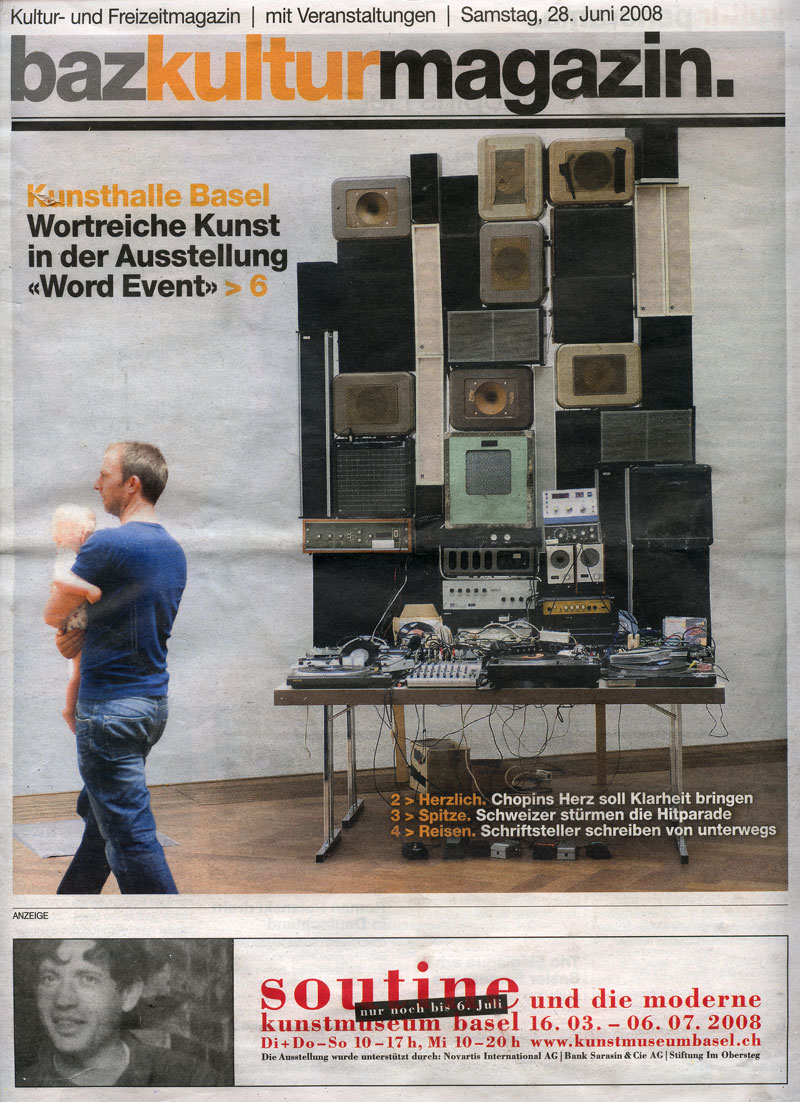
STILLE UNS L�RM. Bei einer Arbeit der Argentinierin Amalia Pica etwa sind die Gegens�tze noch vereint: Die Projektion von Dias eines Megafons auf die Saalecke l�sst Stille und Lautst�rke verschmelze und bringt, wenn auch kleine h�rbaren Worte, so doch die W�rtlichkeit - die Arbeit heisst <<Speaker's Corner>> - ins Spiel. Die Werke das bekannten Detroiter Künstlers James Lee Byars un von André Avelãs aus Amsterdam hingegen teilen die Extreme untereinander auf: Byars' <<The Golden Hole for Speech (A Perfect Whisper)>> von 1981 ist eine riesige Glasplatte mit winzigem Loch, mit der man sich verschiedene <<Word Events>> vorstellen kann, aber eben leise oder gar stumme. Avel�s hingegen hat eigen furchterregenden Verst�rkerturm aufgebaut, vor dem er in Performances mit Plattenspielern deformierte oder neu zusammengeschusterte Tontr�ger abspielt, sie fast mit Guant�namo-Methoden zum Sprechen und Klingen bringt. Kopsa fasst die Anspr�che der Schau anhand eines Werks von Falke Pisano aus Amsterdam zusammen: <<Wir zeigen hier <A sculpture turning into a conversation>, eine Doppelvideoprojektion, in der fast alchemistisch der �bergang zwischen einer Skulptur und einem Dialog herbeigef�hrt wird. Was wir parallel erreichen wollen, ist <An exhibition turning into a conversation>.

Wenn wir es also mit Sprache gewordener Kunst zu tun haben, gleich die dritte Frage: Was kann der Besucher aus dem Dialog der verschiedenen Positionen lernen? vor allem eins: Sprache spielt in der aktuellen Kunst wieder vermehrt eine Rolle, und nicht nur als wohldurchdachter Werktitel, sondern immanent im Werk, wenn auch manchmal nur als Schweigen. Daf�r ist sicherlich auch die aktuelle Vogue eines altgedienten SprachKonzeptk�nstlers wie Lawrence Weiner ein Indikator. Die Kuratorinnen nennen das einen kunsteigenen <<linguistic turn>>, nach dem philosophischen Paradigmenwechsel des letzten Jahrhunderts, wonach die Grenzen unserer Welt innerhalb unserer Sprache liegen. Auch die ausgestellten Werke bewegen sich innerhalb linguistischer Mechanismen, reizen diese aber in verschiedene Richtungen aus.

W�RTLICHE KUNST. Das unterscheidet die Positionen von ihren Fluxus-Vorg�ngern, denen Ausfl�ge in die Musik oder ins Happening n�her lagen. War f�r jene Kunst und Leben nicht zu trennen, geh�ren f�r die hier ausgestellten K�nstler Kunst und Sprache zusammen. Vielleicht ist die vermeintliche Zukunftsmusik, die aus Ellimans S�ancetischchen ert�nt, kein Bluff und wird die Kunst zum <<Word Event>>, sprechen K�nstler statt bildlich bald vorwiegend w�rtlich? Mit der Bilddom�ne Malerei, die in dieser Austellung wohl wegen ihrer prinzipiellen Verweigerung von Wortsprache nicht vertreten ist, kann es die linguistische Kunst allemal aufnehmen, zumal Erstere ja immer wieder von Nahtoderfahrungen zur�ckkehrt.

Abschliessende Frage ans Fluxus-Medium: Lohnt sich ein Besuch der Ausstellung? Das Glas steuert ohne Umschweife zu <<Yes>>. Dann wollen wir mal.


by Daniel Morgenthaler

in Baz Kultur Magazin., Samstag. 28. Juni 2008


-- translation --


A Life in Fluxus


In the exhibition <<Word Event>>, art doesn't lack words.

Starting today, artworks at the Kunsthalle Basel celebrate Fluxus: The group exhibition <<Word Event>> evokes the spirit of the 1960s and 70s art movement through eloquent works.

Something completely different: an exhibition that anticipates prophecies. This is made possible by a work by London-based artist Paul Elliman at the entrance to the Kunsthalle's skylit hall: His <<Maciunas Ouiji board>> is a séance table on which the artist's signature letters, formed from object outlines, are distributed, surrounded by a <<No>> and a <<Yes>>. An opportunity to clarify a few questions about "Word Event," a group exhibition featuring some twenty artists from diverse backgrounds, right from the start.

The first, obvious question: What is a "Word Event"? The best person to ask is the spirit of the musician John Cage, who died in 1992—the first afterlife source for such information. One of his lectures in New York, whose core message, in a nutshell, was to make a lot out of a little, resulted in a project by his student George Brecht: In 1961, the New York artist wrote the simplest stage directions for actions on cards, for example, "Word Event, Exit." "But what a Word Event is remains completely open," adds Maxine Kopsa, who curated the exhibition together with Roos Gortzak. Perhaps one could define, as a minimum requirement, that something happens with language?

CONTEMPORARY ADAPTATION. Sue Tompkins, for example, takes up Brecht's idea and places tiny, typewritten word events on large-format newsprint. By using inexpensive materials, it simultaneously aligns itself with a larger context: Both Brecht and George Maciunas, the namesake of the glass-back table, belonged to the Fluxus movement, that definition-averse group of artists who, in the 1960s and 70s, refused to separate art from life—for example, by integrating everyday objects—and the individual art forms from one another, such as when visual artists also ventured into music.

... A contemporary adaptation of the idea of ​​literal hardship entering art is the work of London-based Walead Beshty: He had glass sculptures shipped from Los Angeles to Basel via FedEx, thus relinquishing control of his work and allowing life to shape it. A fate that, through global circulation, can also befall other artworks, much more unintentionally.

So far, however, all three exhibited works are quite disparate. Therefore, the second question for the medium is: How can the common thread running through the exhibition be captured in words? Even the future envisioned in the mini-session hesitates and ultimately evades the question, for a titular "Word Event" with its definitional openness is, quite simply, a work: Instead of a strictly adhered line, the exhibition presents poles between which a whole world of positions then swirls. Elliman's little table, quite prophetic, provides a beautiful image of this with its uneven letters between the extremes "Yes" and "No." And the visitor, just like the tilted glass, is carried from work to work until they have found their own answer to the initial question.

SILENCE AND NOISE. In a work by the Argentinian artist Amalia Pica, for example, the opposites are still united: The projection of slides from a megaphone onto the corner of the hall merges silence and sound, bringing veracity—albeit only small, audible words—into play. The works of the well-known Detroit artist James Lee Byars and André Avelãs from Amsterdam, on the other hand, divide the extremes between them: Byars' 1981 piece, "The Golden Hole for Speech (A Perfect Whisper)," is a huge glass plate with a tiny hole, through which one can imagine various "word events," but quiet or even silent ones. Avelés, on the other hand, has erected his own terrifying amplifier tower, in front of which he plays deformed or reconstructed sound carriers in performances using turntables, making them speak and resonate almost with Guantanamo-like methods. Kopsa summarizes the exhibition's aims using a work by Falke Pisano from Amsterdam as an example: "Here we are showing 'A sculpture turning into a conversation,' a double video projection in which the transition between a sculpture and a dialogue is brought about almost alchemically. What we want to achieve in parallel is 'An exhibition turning into a conversation.'

So, if we are dealing with art that has become language, the third question is: What can the visitor learn from the dialogue between the different positions? Above all, one thing: Language is playing an increasingly important role in contemporary art again, and not


by Daniel Morgenthaler

in Baz Kultur Magazin., Sunday, 28th Juni 2008


(google translated)


--> scans 01 02 03


-------------
top


-- HET PAROOL, 05.09.2005 --


Te mooi week voor kunst

Galerieweekend in zonnige stad trekt minder publiek dan normaal

by Daphne Lentjes

(...)
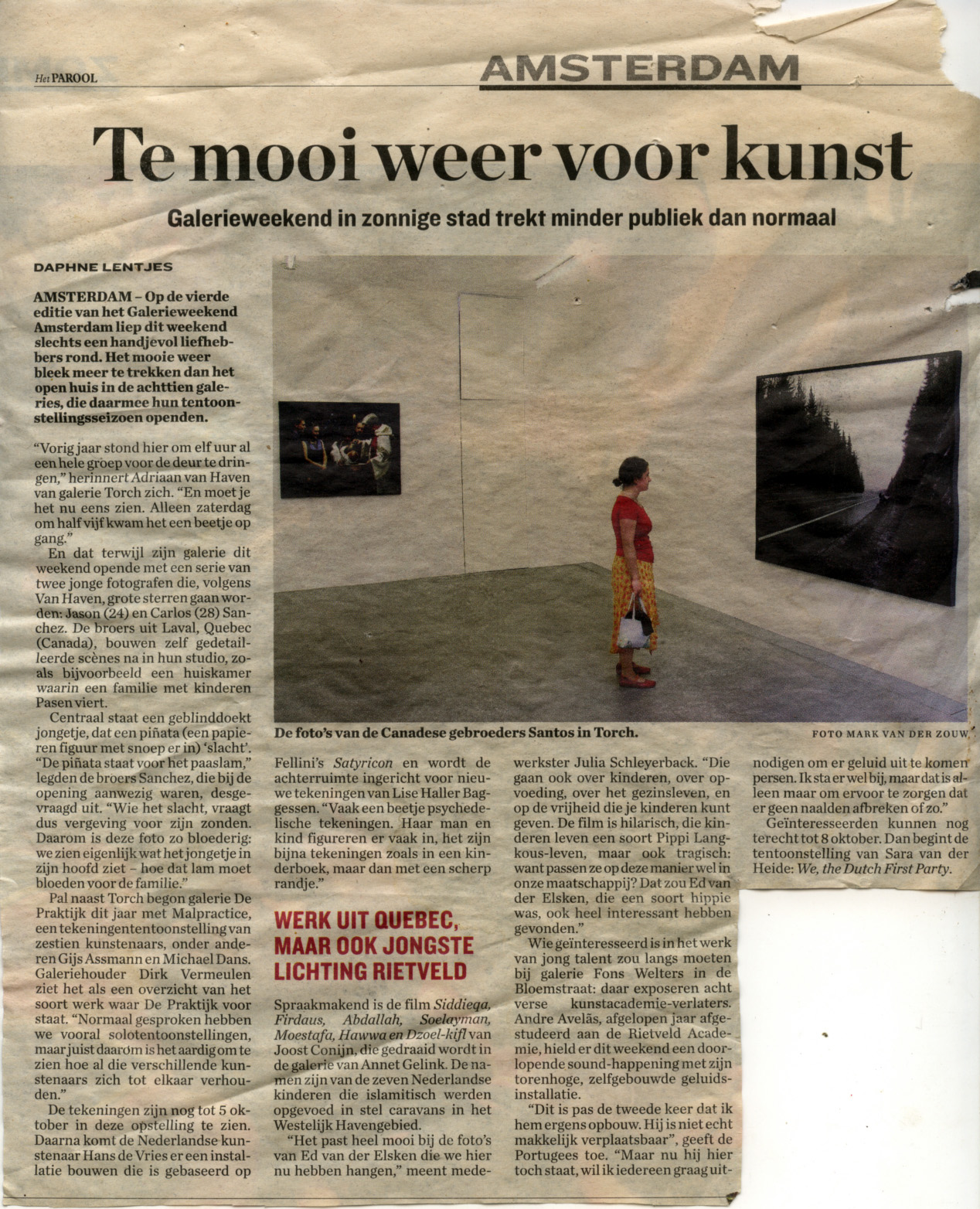
Wie geinteresseerd is in het werk van jong talent zou langs moeten bij galerie Fons Welters in de Bloemstraat: daar exposeren acht verse kunstacademie-verlaters. André Avelãs, afgelopen jaar afgestudeerd aan de Rietveld Academie, hield er dit weekend een doorlopende sound-happening met zijn torenhoge, zelfgebouwde geluidsinstallatie.

"Dit is pas de tweeder keer dat ik hem ergens opbouw. Hij is niet echt makkelijk verplaatsbaar", geeft de Portugees toe. "Maar nu hij hier toch staat, wil ik iedereen graag uitnodigen om er geluid uit te komen persen. Ik sta er wel bij, maar dat is alleen maar om ervoor te sorgen dat geen naalden afbreken of zo."

Geinteresseerden kunnen nog terecht tot 8 oktober.
(...)


-- translation --


Too beautiful a week for art

Gallery weekend in sunny city draws fewer visitors than usual

by Daphne Lentjes

(...)
Anyone interested in the work of young talent should visit Gallery Fons Welters on Bloemstraat: eight recent art academy graduates are exhibiting there. André Avelãs, who graduated from the Rietveld Academy last year, held a continuous sound happening there this weekend with his towering, self-built sound installation.

"This is only the second time I've set it up somewhere. It isn't exactly easy to move," the Portuguese artist admits. "But now that it's here anyway, I'd like to invite everyone to come and squeeze some sound out of it. I will be standing right there, but that's just to make sure no needles break or anything."

Those interested can still visit until October 8.
(...)


in Het Parool, 05-09-05

--> scanned article 01


------------- top